The health impacts of climate change - and what it means for business
Anna Triponel
January 23, 2026
The World Economic Forum (WEF), in collaboration with the Boston Consulting Group, published an insight paper on Building Economic Resilience to the Health Impacts of Climate Change (September 2025). This insight report delves into the human health-related impacts of climate change and outlines scalable, cost-effective interventions for four highly exposed economic sectors: food and agriculture, built environment, health and healthcare, and insurance.
Human Level’s Take:
Climate change is already significantly impacting human health and these impacts are expected to worsen. If left unaddressed, climate change could result in 14.5 million excess deaths and $12.5 trillion in economic losses by 2050
Climate-driven health risks disproportionately affect the most vulnerable and disadvantaged, including women, children, older adults, low-income communities, migrants or displaced people, and those with underlying health conditions
These same groups often lack the resources to adapt, creating a vicious cycle in which climate shocks deepen existing health and economic inequalities
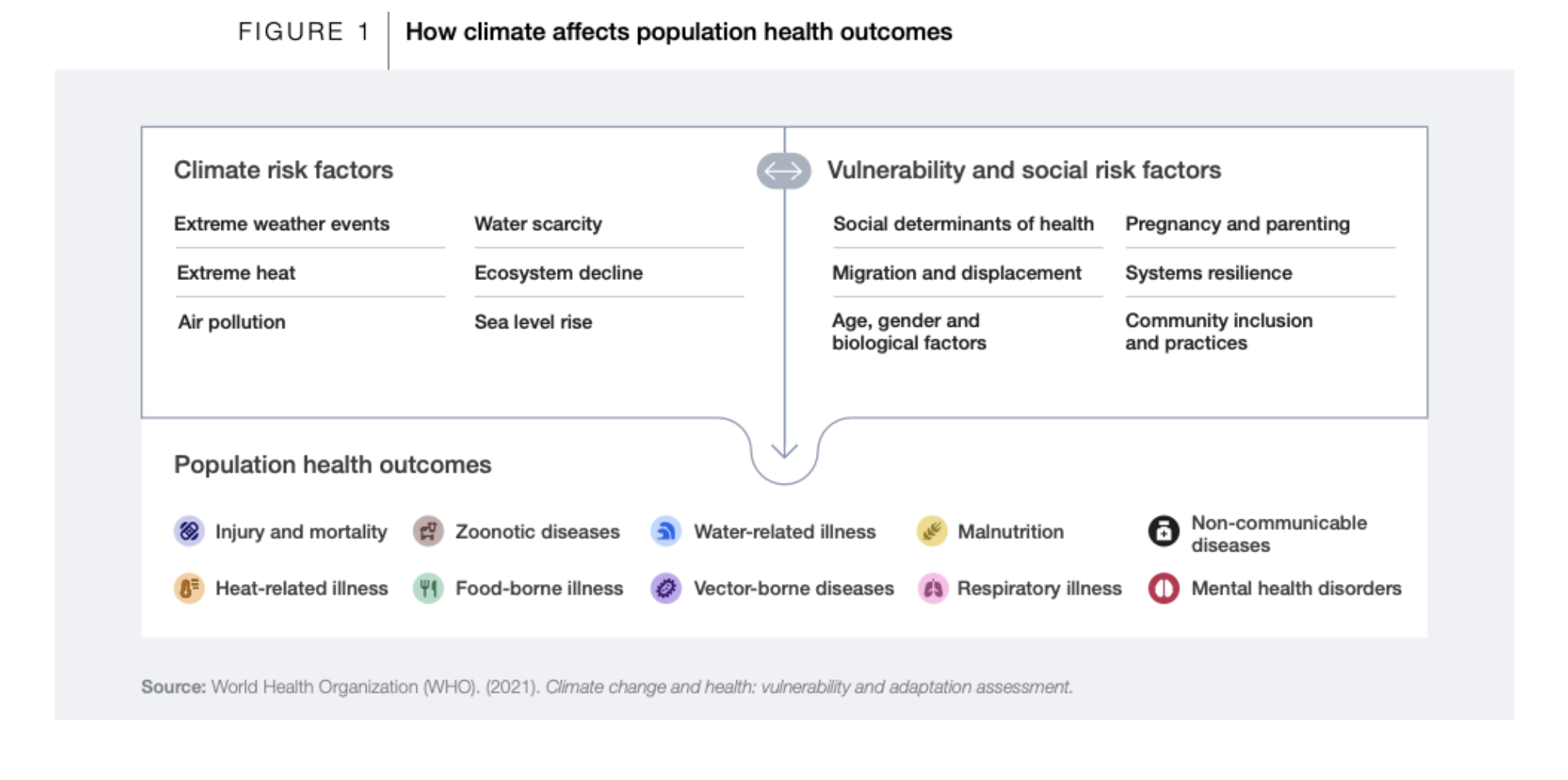
Climate-driven health risks and outcomes are wide-ranging and can be fatal. Impacts include injury and mortality; heat-related illness; zoonotic and vector-borne diseases; water- and food-borne illness; malnutrition; respiratory and non-communicable diseases; and mental health disorders
Four sectors are highly exposed to climate-related health impacts: food and agriculture, the built environment, health and healthcare, and insurance
The report calls on business leaders to embed climate-health resilience into core business strategy today
Business leaders can take three strategic actions:
Understand and prioritise health risks most relevant to their workforce, customers, and communities, focusing on the most severe and likely threats
Plan and implement interventions that safeguard health and build resilience, prioritising high-impact, “no-regret” actions that reach the largest share of the workforce or customer base and deliver co-benefits such as climate mitigation, sustainability, and social impact
Collaborate with public agencies, NGOs, philanthropies, and peers to pool resources and knowledge, amplify impact, and drive systemic change
Proactive adaptation today is significantly more cost-effective than reactive responses to escalating disruptions, while also strengthening long-term stability and competitive advantage
Some key takeaways:
The health impacts of climate change is already significant, and will only grow in magnitude: The report identifiesfour highly exposed sectors to climate-driven health risks (i.e., food and agriculture, built environment, health and healthcare, and insurance). Chronic climate stressors undermine the foundations of good health (e.g., clean air, safe water, stable temperatures, sufficient food, secure shelter), while extreme weather events directly threaten health. If left unaddressed, climate change could result in 14.5 million excess deaths and $12.5 trillion in economic losses by 2050. Climate-driven health risks disproportionately impact the most vulnerable and disadvantaged, including women, children, the elderly, poor communities, migrants or displaced persons, and those with underlying health conditions. For example, 56% more health-related deaths occurred among women than men in Europe between 30 May and 4 September 2022. At the same time, these groups lack the resources to adapt to climate change, creating a vicious cycle in which climate shocks deepen existing health and economic inequalities. Climate-driven health risks and outcomes are wide-ranging and can, in some cases, be fatal (see Figure 1 below). Health risks and outcomes include injury and mortality; heat-related illness (e.g., heatstroke and cardiovascular stress); zoonotic diseases (e.g., Ebola and COVID-19); vector-borne diseases (e.g., malaria, dengue, Zika, and Lyme disease); water-related illness (e.g., cholera, typhoid, and dysentery); food-borne illness (e.g., salmonella, E.coli and norovirus); malnutrition; respiratory illness (e.g., respiratory tract infections, pneumonia, asthma, chronic obstructive pulmonary disorder, and lung cancer); non-communicable diseases (e.g., pregnancy complications, adverse birth outcomes, and chronic illnesses); and mental health disorders (e.g., anxiety, depression, and post-traumatic stress disorder).
What businesses in all sectors can do: The report outlines eight interventions that companies can take, irrespective of sector, to address the health impacts of climate change. In many cases, companies will be able to go further, as well as prioritise actions tailored to their specific contexts. The eight interventions are:
Implement occupational health safeguards for workers in high-risk zones (i.e., regions vulnerable to climate impacts). This could include providing workers with medical care and personal protective equipment, implementing cooling solutions, and modifying work practices
Provide climate-responsive employee health coverage. This involves expanding employee health benefits to cover relevant climate-driven conditions
Implement risk monitoring and early-warning systems. This includes continuously tracking indicators - for example, meteorological data, disease outbreak data and workforce health metrics - to enable businesses to anticipate and reduce health and operational risks before crises escalate
Invest in climate-health research.This helps to identify the root causes of climate-health risks and develop new treatments, technologies and preventative strategies
Protect critical systems, including both built and ecological infrastructure. People rely on these systems for food, shelter and health but climate change is eroding them, for example, through degraded farmlands and vulnerable infrastructure
Establish preparedness and response plans for climate-related health emergencies and the changing profile of climate risk. This can involve, for example, training workers and spreading awareness of specific climate-health protocols
Educate workers and communities on climate-health literacy, enabling people to take informed action on their own health
Scale health-protective products and services that reduce long-term health burdens across the value chain, for example, innovations and tools that address the root causes of climate-exacerbated disease, and diagnose and treat emerging conditions
What business leaders can do: The report ends with a call to action to business leaders: “embed climate-health resilience into core business strategy today.” Proactive adaptation is a lot more cost-effective than spontaneous response to escalating disruptions, and it builds long-term stability and competitive edge.The reportalso outlines three strategic actions that can guide an effective climate-health resilience strategy. These are:
Understanding the health risks most relevant to workforce, customers and communities, which involves 1) assessing climate-health exposure across operations and supply chains; 2) prioritising the most severe and likely health threats; and 3) using data and early-warning systems to anticipate health impacts
Prioritising, planning and conducting interventions to safeguard health and build resilience. This means 1) prioritising high-impact, “no-regret” actions that reach the largest portion of their workforce or customer base and significantly reduce risk; 2) assessing actions’ required investment, feasibility and time-to-value, aiming for a balance between quick wins and longer-term investments; and 3) looking for interventions that deliver co-benefits in areas like climate mitigation, sustainability or social impact; 4) designing measures that fit the organization’s size and industry and embedding these into core business strategy; and 5) evaluating interventions for unintended consequences. For instance, relying solely on air conditioning can increase emissions, ultimately exacerbating climate risks
Collaborating to amplify impact and cultivate systemic change. Companies can work with public agencies, non-governmental organisations, philanthropists and peers to pool resources and learnings to avoid duplication of effort and magnify impact. Critically, companies can collaborate across sectors where opportunities are plentiful. For instance, agribusinesses can partner with insurers to develop climate-specific coverage for crop losses