The World Economic Forum (WEF), in collaboration with McKinsey & Company, has published the report ‘Making the Green Transition Work for People and the Economy’ (November 2025). In it, they analyse the impacts of the changing socioeconomic landscape on the transition and argue for a reframe of climate action to ensure it also serves people and the economy.
Human Level’s Take
More key takeaways:
The changing global context is affecting global views of climate action: The report argues that recent shifts in the global economic and political landscape are reshaping expectations related to climate action. Some of these compounding factors include the intensifying geo-economic competition, showcased by the expansions of industrial incentives across the EU, US and China and the growth of bilateral trade agreements; the largest inflationary episode of the past 50 years, with inflation peaking at 8.6% in 2022, after the pandemic; and increased inequality within and across countries, which is limiting economic opportunities and contributing to political divides. At the same time, many developing countries now face acute debt-servicing pressures and strained multilateral cooperation, limiting the availability of resources for the transition. Companies, in addition, report mounting worries about competitiveness due to higher energy and commodity costs and regulatory uncertainty. These combined pressures risk creating a landscape of uneven access to capital and green technologies – especially for lower-income economies, where more than one in five companies lack access – and slowing down a just and effective transition.

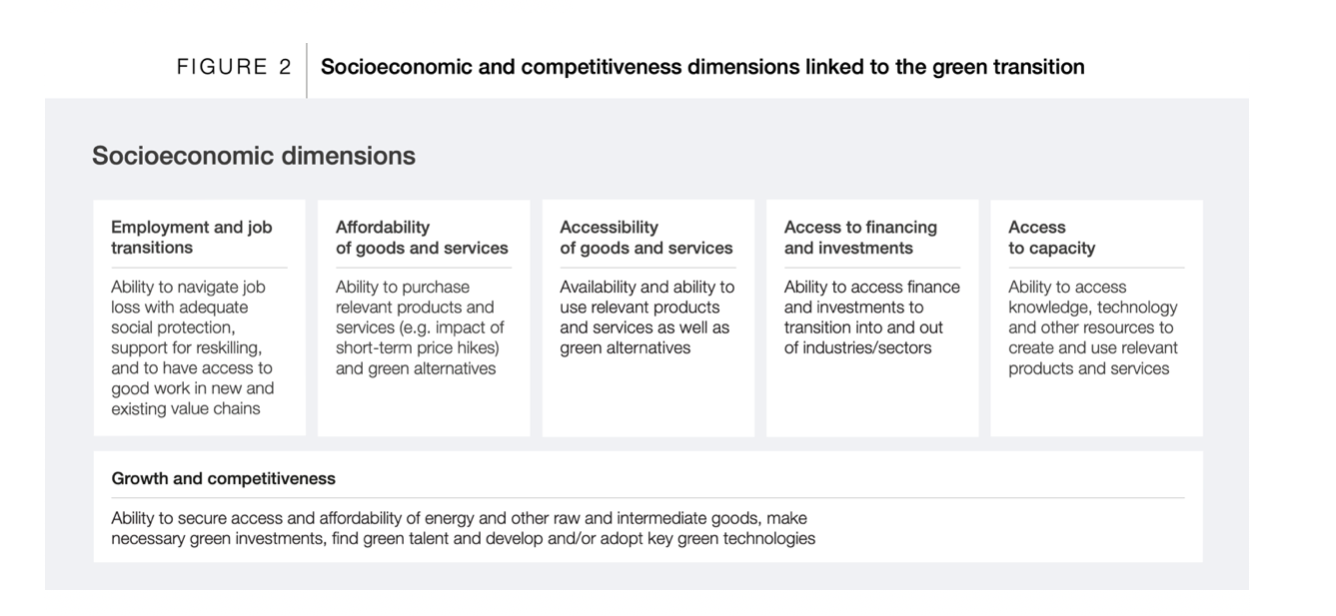
The green transition needs a new narrative: climate action aligned with the needs of people and the economy: In this context, the report argues, the green transition needs a new narrative - one that aligns climate ambition with the needs of workers, households, businesses and communities. Without it, labour disruptions, wage stagnation, goods and services becoming more expensive or less accessible, and green energy becoming less affordable could weaken support for climate action. Six major socioeconomic impact that should be considered when re-framing green energy approaches are: (1) the affordability of goods and services, since prices will grow as growth slows, inflation rises and capital costs increase; (2) access to goods and services, which can be limited by shifting globalisation patterns and the decommissioning of high emission assets; (3) access to capacity, since skills, know-how and technological capabilities may become concentrated in a few regions, weakening the competitiveness of smaller companies and less developed countries; (4) access to financing, as tightening fiscal conditions and higher interest rates make credit less accessible for households and businesses; (5) employment and job transitions, as transition-related activities may exacerbate existing gaps in education, healthcare and job quality; and (6) growth and competitiveness, since the overall net economic impact of the transition remains uncertain. For climate action to succeed, the report argues, people should be placed at the heart of climate action “by embedding socioeconomic considerations into green transition planning and understanding the co-benefits and trade-offs associated with different transition pathways faced by stakeholders.”
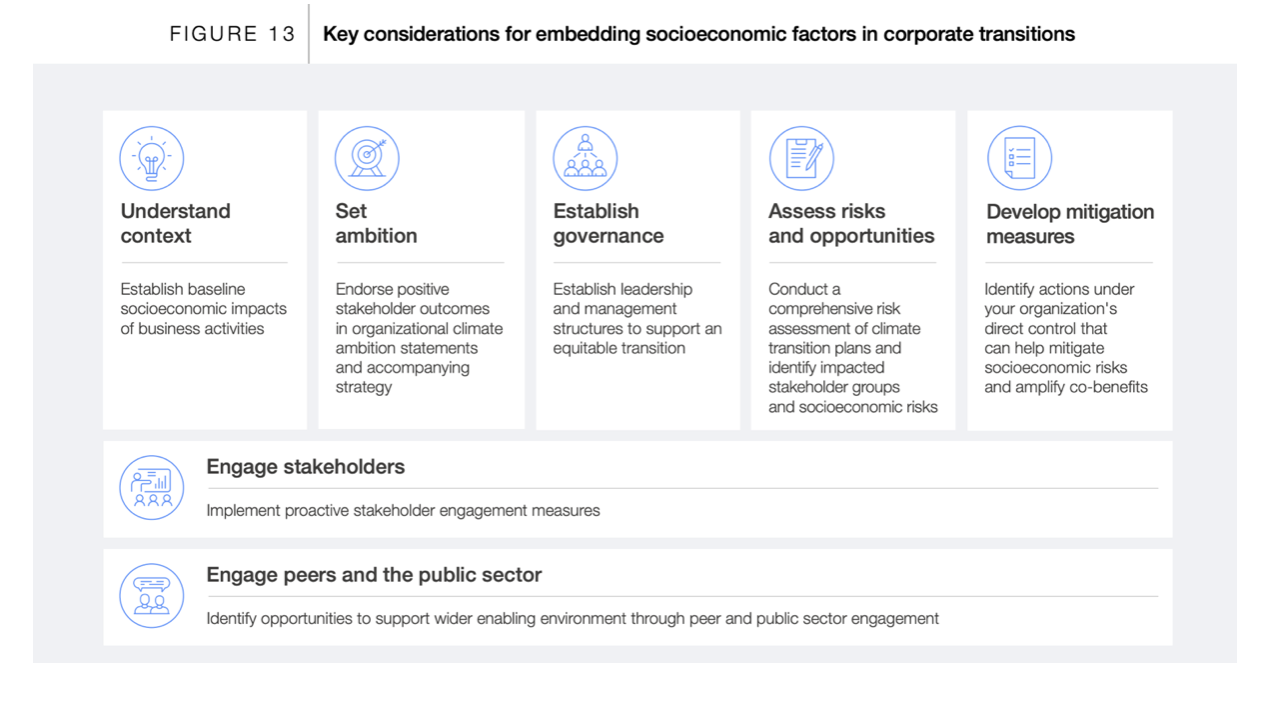
Companies can begin to change the narrative by integrating social considerations into climate action: While companies’ commitment to the transition is accelerating, with more than 8,700 companies now having SBTi-validated targets, poorly managed transitions may reinforce socioeconomic challenges and erode a company’s social licence to operate. The report argues that companies can help shift the narrative on climate action and increase its effectiveness by integrating social considerations into their transition plans, considering impacts to their own workforce, value chain producers, manufacturers and workers, consumers, and communities. Seven key steps are recommended for embedding socioeconomic factors into corporate climate strategies: (1) understand the context by establishing baseline socioeconomic impacts of current business activities; (2) set ambition by committing to positive stakeholder outcomes within climate goals and strategies; (3) establish governance systems that enable an equitable transition; (4) assess risks and opportunities to identify who is affected and where socioeconomic risks arise; (5) develop mitigation measures that companies can directly implement to reduce harm and increase co-benefits; (6) engage stakeholders throughout, to ensure transparent, inclusive decision-making; and (7) engage peers and the public sector throughout, to strengthen the broader enabling environment for a just and effective transition.