The Institute for Human Rights and Business (IHRB) published a new report, Making Just Transitions Work: Lessons for Business Leaders (January 2026), showcasing four examples of how just transitions are being advanced in practice across different sectors.
Human Level’s Take
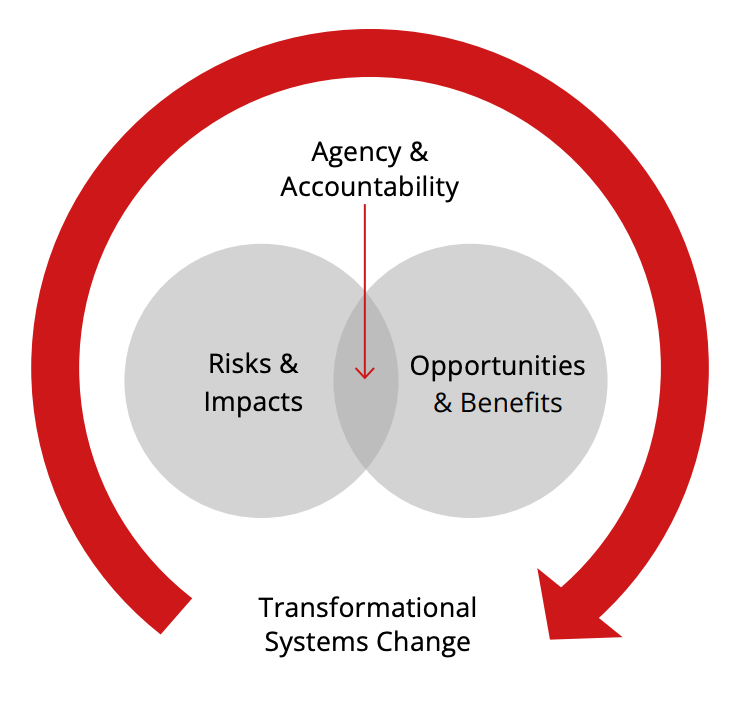
Just transition cannot be just a theoretical concept, especially as the climate emergency is progressing faster than policy alignment or shared definitions around just transition can. Initiatives like IHRB’s Just Stories and this report are helping translate principles into practice. As transition-related impacts can vary significantly across sectors and geographies, there isn’t a single way to have a just transition. Each sector, company and geography will need to design a transition that is just in their context, but key principles apply across the board: (1) opportunity creation, (2) risk mitigation, (3) meaningful engagement and (4) transformational systems change.
The report offers examples that show how these just transitions look like in practice, from the regenerative agroforestry transition in Brazil and the transition to solar energy in salt farming in India, to the development of housing options in Spain that integrate social justice and environmental sustainability, and the phasing out of coal mining in Western Australia through investment in green industries and worker retraining.
Across the four case studies, just transitions are driving business growth and long-term value creation — as well as of social resilience. They are shaping access to capital, workforce stability, regulatory alignment and long-term competitiveness. They are also mitigating risks of climate impacts, low productivity, loss of jobs, reputational damage and long-term supply that would come with not transitioning or not doing so in a just way.
However, just transitions remain complex to implement and the report acknowledges these challenges. To support company action, the report provides guiding questions to help businesses identify transition risks to people, manage trade-offs, and embed just transition into their climate transition plans and broader business strategies.
Some key takeaways:
Broad definitions of just transition take shape through practical examples: As the attention to the social impacts of decarbonisation grows, business leaders are increasingly seeking clarity about what just transition means in practice. When defining just transitions, the report highlights that just transitions involve a a whole-of-society approach to decarbonisation that respects human rights (mitigating risks) while promoting sustainable development and the creation of decent work and quality jobs (creating opportunities). Additionally, it restates that just transitions should drive transformational and systemic change. For businesses, this requires embedding human rights considerations into climate transition planning, as well as considering how investment, procurement, employment and exit decisions play a role in shaping whether transitions are inclusive and durable.
Key pillars of a just transition: opportunity creation, risk prevention, meaningful engagement and transformational systems change.
Opportunity creation: The transition presents an opportunity to rethink how businesses create value, unlocking new markets and income streams. For example, in Brazil, agroforestry start-up Belterra is selling climate solutions by integrating forestry into crops like cacao, açaí and mahogany, which also diversifies and improves farmer incomes. Similarly, in Gujarat, India, replacing polluting generators with solar energy in salt mining operations has reduced operating costs by 60% and enabled women farmers to increase earnings by up to 600%. In other regions, the transition is attracting increased investment into green manufacturing and infrastructure, benefiting local workers and investors alike.
Risk mitigation: Just transition approaches also require considering and mitigating human rights risks, which helps businesses simultaneously manage risks from climate change and long-term resilience. In Brazil, the funding that companies like Natura and Cargill are investing in agroforestry has led to increased incomes for farmers, many of which are part of Afro-descendant Quilombola, Indigenous and riverside communities.
Meaningful engagement: Ongoing collaboration between businesses, workers, communities and governments is foundational to just transitions, but also increases stakeholder trust in companies and their social license to operate. In Gujarat, ReNew’s investment in supporting salt farmers to transition into renewable energy has expanded the local talent pool needed to scale the renewables sector in the region — which benefits the investors. Similarly, in Spain, community-led property development leads to less speculative real estate markets and a more stable and reliable return on investment.
Transformational systems change: Finally, broader system-level changes, innovation, re-skilling and new business models are common traits of these examples and just transitions. In regenerative agriculture in Brazil, this has involved relying on ‘train-the-trainer’ or similar multiplier models that support knowledge transfer at scale among farmers.In Gujarat, women farmers being trained on solar pump use are becoming key agents of technological and environmental innovation, building local skills for increased renewable energy adoption. And, in Collie, Australia, similar system-wide transformations are being coordinated by the Just Transition Working Group (JTWG), which comprises government, unions, community representatives and employers. Among other achievements, they are ensuring workers can be re-skilled before their jobs are lost.
Remaining challenges and a call to action: While the business case for just transitions and pathways for implementation are becoming clearer, challenges remain — particularly for companies operating across diverse geographies and sectors. Legacy infrastructure, long investment cycles, and evolving expectations around governance, measurement and reporting can slow progress. So can supply chain complexity. To chart pathways for action in an uncertain climate, the report provides guiding questions for businesses to better identify risks, manage trade-offs, and embed the four pillars of a just transition into their transition and broader business strategies. Companies are also asked to continue piloting solutions and sharing progress and challenges, so that others can begin or continue to advance.