Attacks against Indigenous, land and environmental defenders
Anna Triponel
December 12, 2025
The Alliance for Land, Indigenous and Environmental Defenders (ALLIED) published Uncovering the Hidden Iceberg 2024 (December 2025), which documents non-lethal attacks against Indigenous, land and environmental defenders from across 46 countries. The data underlying the findings (produced by a group of local, regional and global data collectors) reveals extensive patterns of violence that can precede the killing of these defenders.
Human Level’s Take:
Non-lethal attacks against Indigenous, land and environmental defenders are significant
In 2022 alone, the ALLIED dataset recorded 916 non-lethal attacks across 46 countries
Victims were disproportionately Indigenous. Only 6% of the global population is Indigenous but they accounted for nearly one in every four attacks
The largest proportion of defenders who were attacked were protecting land, accounting for 39.8% of the total. Defenders protecting territory, the environment in general, and customary rights closely tied to land and territory, accounted for another 25%, 16.7%, and 6% of attacks, respectively. Defenders attacked in connection with forest protection contributed to more than 15% of attacks in Burma, Indonesia and Madagascar
This has got worse and will likely get even worse due to climate change and environmental degradation. The climate crisis has lent an urgency to the defence of land, territories and natural resources, while the green transition has also posed new threats to defenders, The largest proportion of defenders who were attacked were protecting land
In addition, violence against Indigenous Peoples, land and environmental defenders has continued unabated, with Indigenous communities, which protect some of the most important global biodiversity hotspots and carbon sinks, being disproportionately targeted
Across all 46 countries analysed, defenders speaking out against industrial agriculture and mining were most at risk, making up 64% of attacks
So, what can companies do? Companies can conduct robust human rights due diligence (HRDD), particularly in areas and sectors that are prone to land conflict, to identify, prevent, mitigate and remediate adverse human rights impacts on Indigenous, land and environmental defenders
They can also be transparent about their HRDD findings and the actions that they are taking or plan to take to address potential or actual adverse human rights impacts associated with their operations
Some key takeaways:
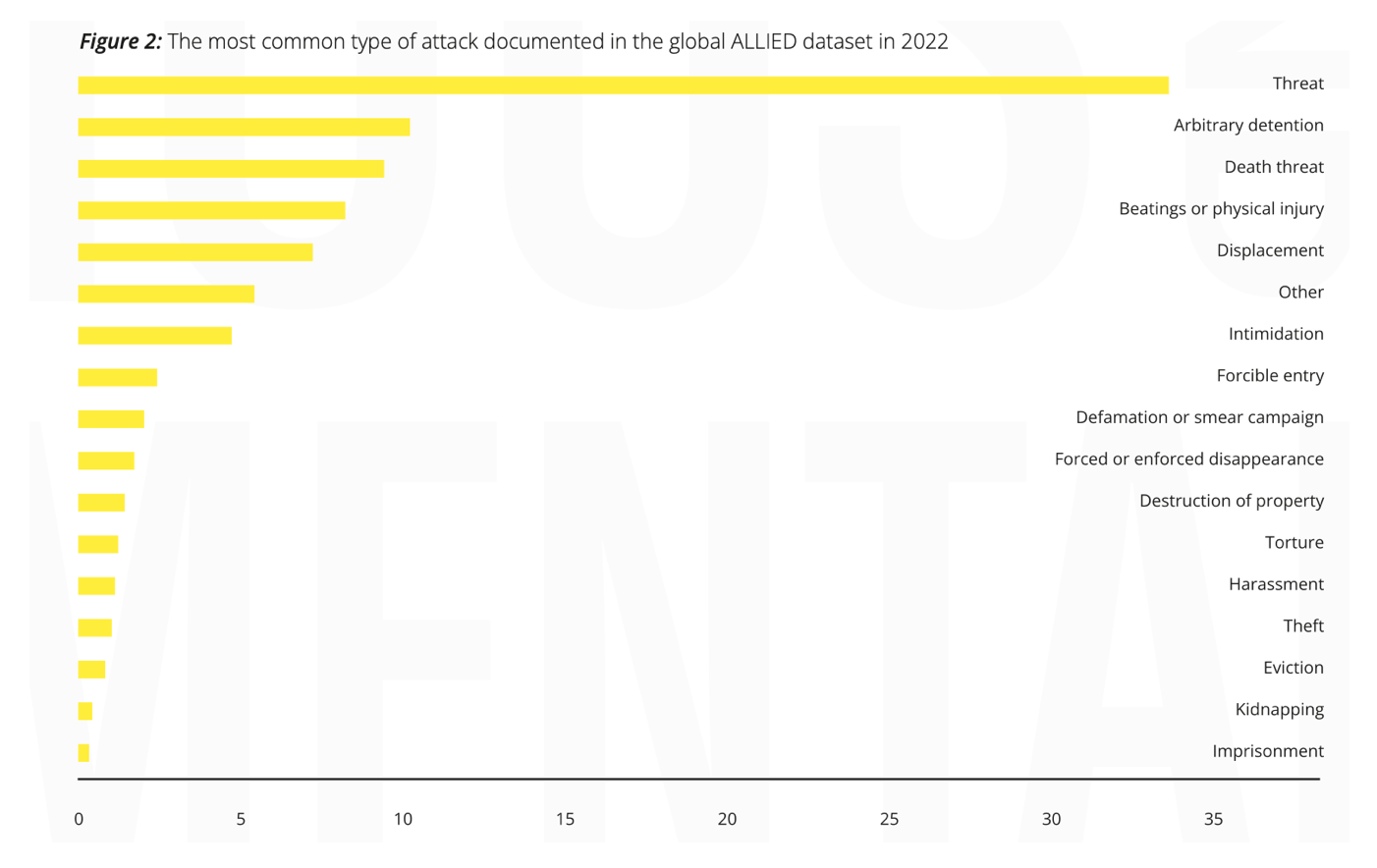
Attacks against Indigenous, land and environmental defenders (ILEDs) are significant: In 2022, as Global Witness documented the deaths of 177 defenders, the integrated ALLIED dataset recorded 916 non-lethal attacks across 46 countries. The majority of attacks were perpetrated against individuals - 64% of the total - while another 30% of attacks were registered against entire communities. This underscores the collective nature of violence endured by those who speak out against harms to land and the environment, but also those who are attacked by affiliation. Threats are the most common type of attack against ILEDs, accounting for 33.6% of the total. Arbitrary detention was the second-most common attack globally, accounting for another 10.2%. Death threats accounted for an additional 9.4% of all non-lethal attacks, while beatings or physical injury accounted for 8.2% and displacement for another 7.2%. Across the 46 countries where ALLIED registered attacks in 2022, Latin America stood out as the region with the most documented violence. The region counted for just over 3 of every 4 attacks committed in 2022, led by high rates of violence in Colombia, Guatemala and Mexico. In other known hotspots, such as the Philippines, few attacks were registered in the global database as local data collectors cited limited capacity and resources to document violence against ILEDs.
Specific groups and individuals targeted: In 2022, 40.5% of all attacks in the ALLIED database were perpetrated against community leaders or members. Another 24.2% attacks were against Indigenous Peoples, despite them being approximately 6% of the global population. A third category of defenders that were affiliated as “other” accounted for 20.2% of attacks, primarily accounting for communities in Colombia that didn’t fall into either of the above categories. Environmental concerns groups accounted for another 3.7% of attacks. The dataset also captured violence against Afro-Colombians and the Garifuna. In 2022, there were 37 attacks perpetrated against Afro‑Colombians, all of which took place in Colombia, and two attacks on defenders identifying as Garifuna, both of which took place in Honduras.
Climate change and the green transition driving attacks: Worldwide, the climate crisis has lent an urgency to the defence of land, territories and natural resources, while the green transition has also posed new threats to defenders. The largest proportion of defenders who were attacked were protecting land, accounting for 39.8% of the total. Defenders protecting territory, the environment in general, and customary rights closely tied to land and territory, accounted for another 25%, 16.7%, and 6% of attacks, respectively. Defenders attacked in connection with forest protection contributed to more than 15% of attacks in Burma, Indonesia and Madagascar. In addition, violence against Indigenous Peoples, land and environmental defenders has continued unabated, with Indigenous communities, which protect some of the most important global biodiversity hotspots and carbon sinks, being disproportionately targeted. Moreover, defenders speaking out against harms caused by the agriculture and mining sectors were consistently most at risk, as the two sectors were linked to 46.5% and 17.9% of attacks, respectively. In 2022, paramilitary forces were the most cited of all probable perpetrators, named in 26% of global attacks where data was available. So, what can companies do? Companies can conduct robust human rights due diligence (HRDD), particularly in areas and sectors that are prone to land conflict, to identify, prevent, mitigate and remediate adverse human rights impacts on ILEDs. They can also be transparent about their HRDD findings and the actions that they are taking or plan to take to address potential or actual adverse human rights impacts associated with their operations.