🧭 An increase in our responsibility
At this week’s Be Human Rights Confident Collective, we talked about two trends we’re seeing.
🌍 The significant funding cuts faced by civil society organisations.
This was discussed in Strasbourg alongside the launch of the recent report by Swedwatch, the European Coalition for Corporate Justice (ECCJ) and the Business & Human Rights Resource Centre (BHRRC) on funding cuts (see below for more on that).
These are the organisations gathering evidence, engaging directly with affected people, challenging companies and governments, and bringing perspectives into the room that companies might otherwise never hear.
And these cuts go beyond reduced capacity. We heard that when staff leave, organisations can also lose relationships with workers and communities built over many years — relationships that may take years to rebuild, even if funding returns at one point.
And we know those cuts are happening alongside growing pressures on civic space: threats against staff, smear campaigns, digital attacks, strategic lawsuits, etc.
🏢 We’re seeing experienced human rights practitioners leaving companies.
We talked about practitioners who, frustrated by the challenges of driving change internally, are deciding to move into consulting or other roles.
When those people leave, companies don’t just lose technical expertise. They lose years of institutional knowledge, internal relationships and the ability to navigate the business and keep pushing human rights into decisions.
🤖 And then this week, in a call on our just-released AI and HRDD discussion paper (see below), I heard about another shift in the advisory world.
I heard about an advisory company prioritising its AI-related risk services while cutting the team that engages directly with companies — in large part because the return on investment was stronger.
So we could be looking at:
🌍 fewer resourced civil society organisations + 🏢 fewer experienced practitioners inside companies + 🤝 fewer advisors doing the deep, human work…
…alongside all the other pressures we already know about: constrained civic freedoms, the climate crisis, geopolitical tensions, the digital transition, conflict and more.
What does that mean for those of us still inside companies, advising them or otherwise working in this field?
I think it increases our responsibility significantly.
🤝 We have to make space for civil society in our work — beyond asking for their input, to finding ways to strengthen, resource and amplify the organisations we rely on.
💰 We have to invest in civil society where we can — financially, through partnerships, by sharing platforms and connections, and by recognising that meaningful engagement requires resources.
🫶 We have to build each other up. Connecting practitioners, sharing knowledge and creating spaces where people can share and level up has become even more important.
❤️🩹 We have to look after the people doing this work. This can be emotionally difficult and frustrating work. Creating space to talk about that — and supporting each other through it — is important.
🤖 We have to keep questioning what AI might remove. Not because we shouldn’t use it, but because relationships, judgement, institutional knowledge and trust can be very difficult or impossible to recreate once replaced.
🧠 We have to preserve and pass on knowledge. When experienced people leave organisations or the field, we need to find ways to ensure that their learning, relationships and experience don’t simply leave with them.
🌱 And we have to keep investing in the human eco-system which is the foundation of this work. The relationships between practitioners, civil society, workers, communities, advisors and others that enable us to challenge, learn from and support one another.
This is the work.
Anna 💫
PS: My newsletter this week delved into our recently-released discussion paper on using AI for HRDD - see here.
PPS: The winner from the PRI Awards was announced last week. I honestly was so impressed by the submissions (I was one of the judges on human rights). The winner, the LBP AM SRI Human Rights Fund, is a fantastic example of working with and building up civil society, see here.
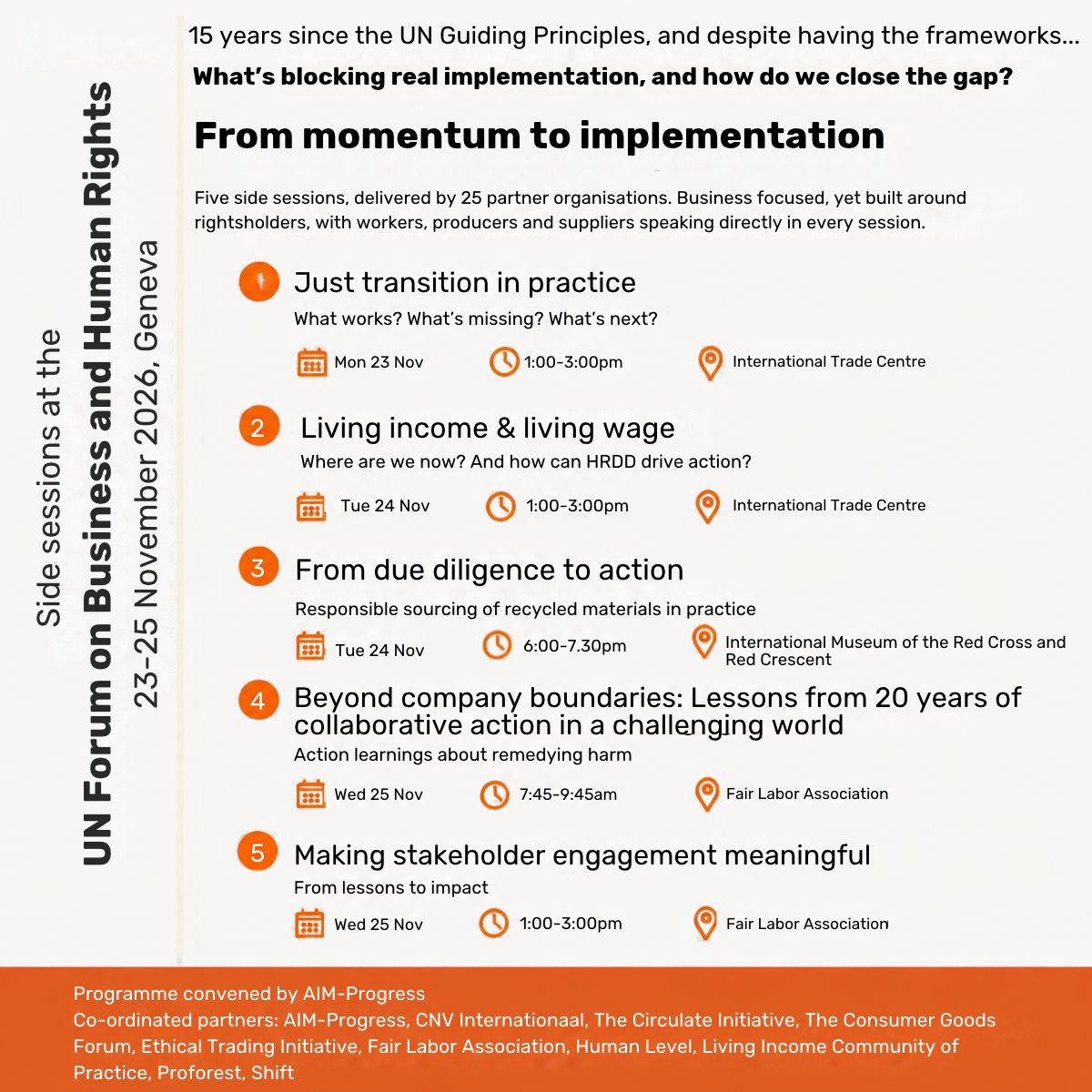
PPPS: Our Geneva just transition sessions - that we are organising in partnership with a number of amazing organisations - are now firming up. See below for one, and if you were at our London event or in our Just Transitions Collective you’ll soon receive an invite to our second one.
PPPPS: How many PS’s are too much, is a question my Grandfather and I would always debate when we were sending letters to each other when I was little. As you can see, we landed on: it’s never too much. 😆